Turning the ‘nitrate timebomb’ into a sustainable solution Mike Waite Agua DB Ltd
history – nitrate removal
1.
> Strong base anion resins were the first on the scene, but these showed nitrate peaking and lead to the development of nitrate selective resins
Nitrate peaking is where the nitrate in the effluent from an IX column exceeds the feed water levels
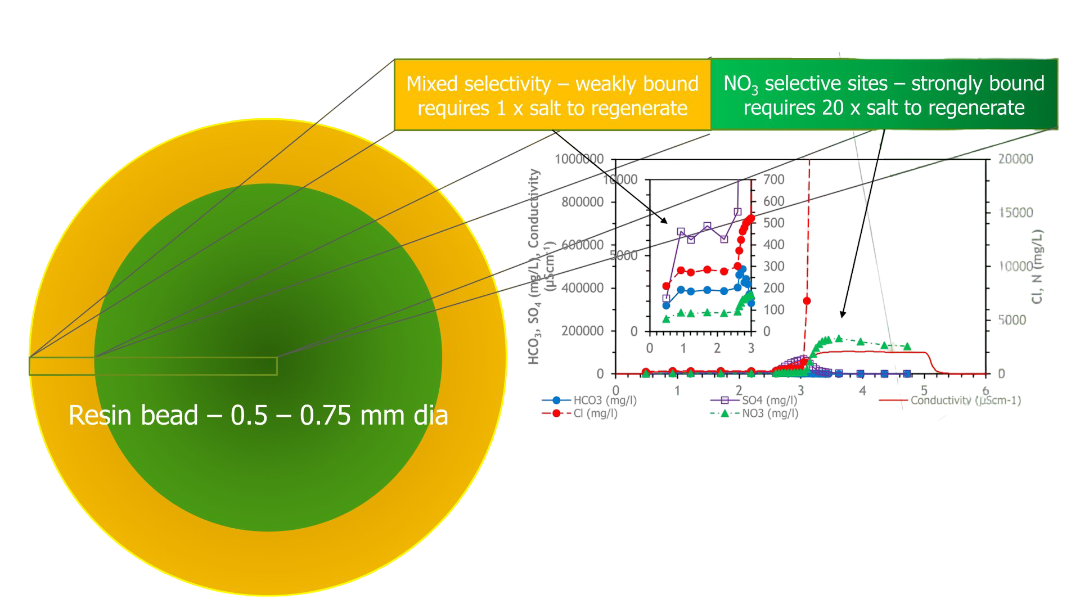
> Nitrate selective resins were made by increasing the degree of cross-linking in the resin structure and incorporating bulkier amines into the structure to favour the single bond with NO3 over the double valent SO4
> We talk later about an inner core of strongly bound nitrate selective sites – what the manufacturers did was to increase the ratio of this core volume to the more easily regenerated outer sites – nitrate peaking still happens on nitrate selective resin, we just don’t see it because there’s sufficient capacity available in the inner core to absorb nitrate sledged off the outer sites
2.
>We developed segmented regeneration – the super efficient regeneration of resins loaded with Cr(vi), and this really started to give us an insight on how these outer 1:1 sites were behaving
> Nitrate peaking showed that this region would still absorb nitrate – can we use just this region of the resin to effectively remove nitrate?
>The answer was ‘Yes!’ – and this is NTPlus
segmented regeneration
Purolite A600e/9149 SBA resin
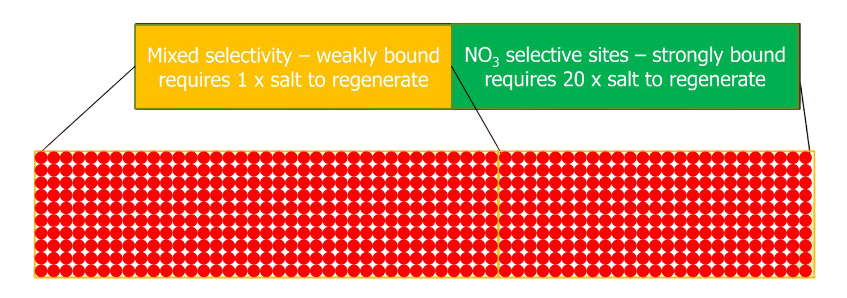
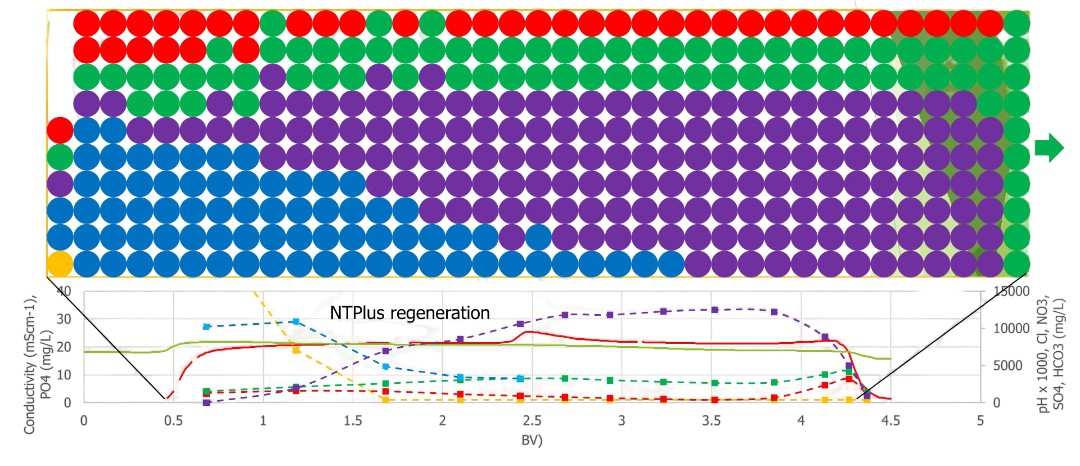
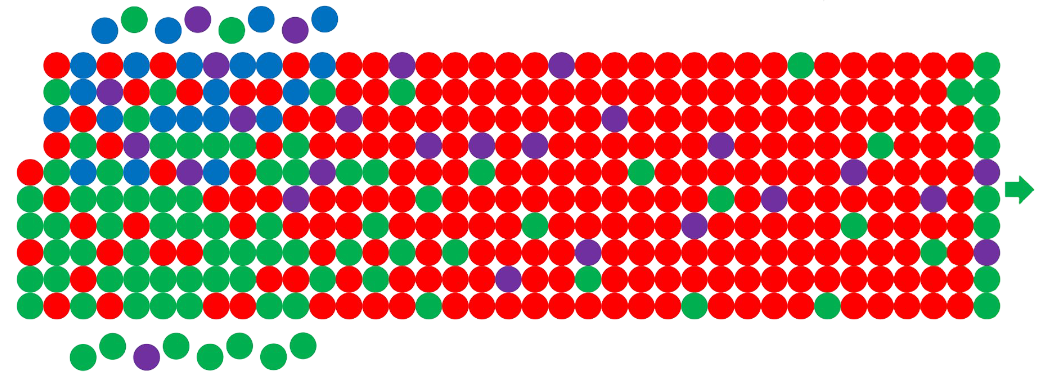
Measured capacity: 65% of functional sites on the resin follow 1:1 reaction kinetics
Let’s look at what happens when we use just these weakly bound sites
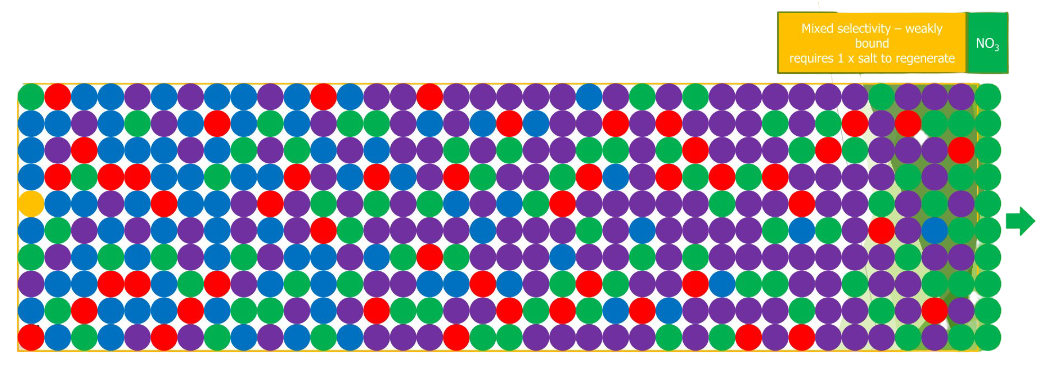
But you can see there’s still some nitrate on these outer 1:1 regenerable sites at the end of a regeneration
This is because when the rinse happens at the end of the regeneration, nitrate in the interstitial solution is re-absorbed back onto the resin. Most goes onto the tightly bound inner core of nitrate selective sites (not shown), but some end up on these outer more labile sites and are displaced by incoming HCO3 and SO4 when the resin is returned to service.
This is the nitrate leakage you see when a column is first returned to service.
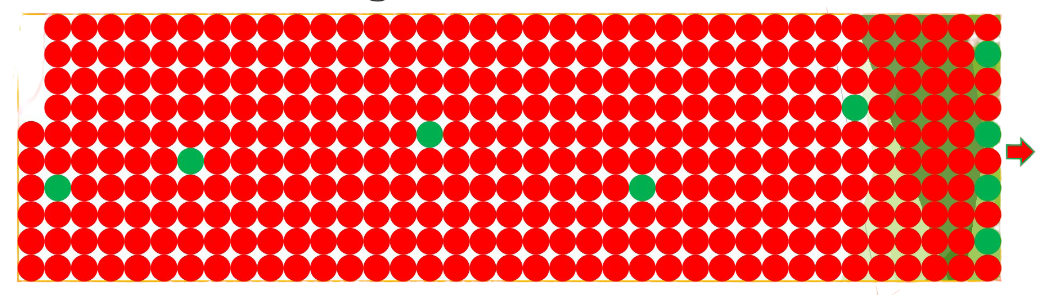
NTPlus only regenerates these outer sites
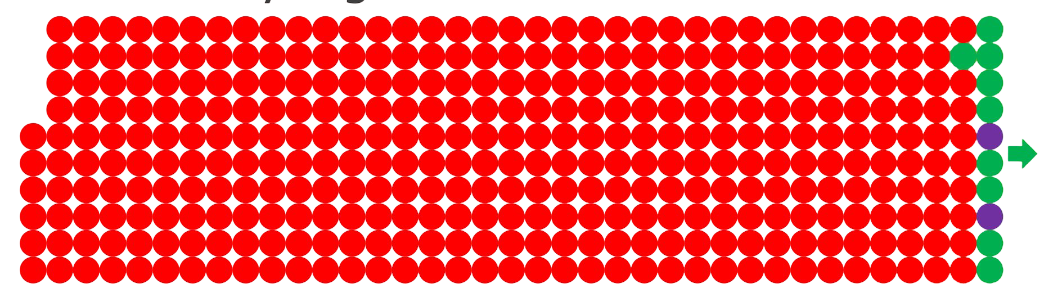
What is really interesting here is that at the end of an NTPlus regeneration, these sites are all in the Cl form (red), but, as the rinse front moves down the column, the interstitial liquid is a mix of sulfate and nitrate – >95% of the Cl feedhas exchanged onto the resin and the bicarbonate was removed early in the regeneration.
This makes the rinse rather interesting…
the rinse
Nitrate is re-absorbed predominantly on these outer bicarbonate selective sites as the rinse occurs – there is no chloride and no bicarbonate competition, and these sites ‘prefer’ monovalents to divalent sulphate
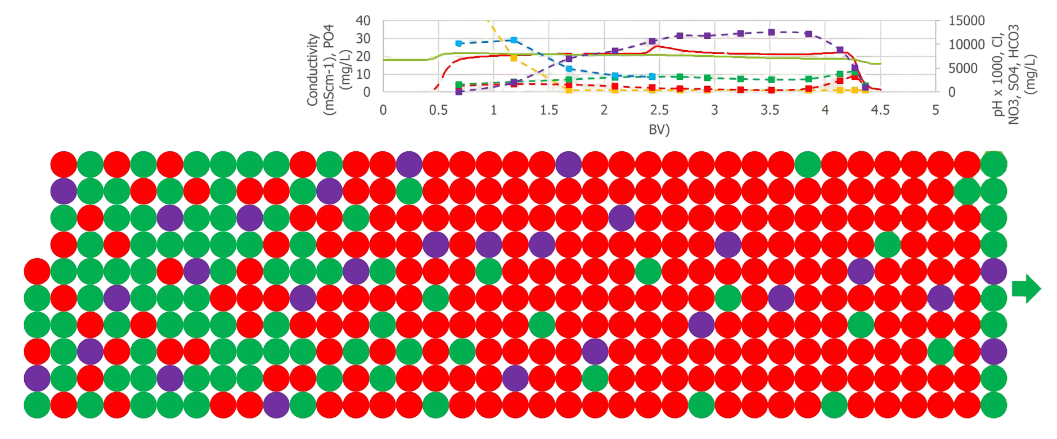
when we return the resin to service
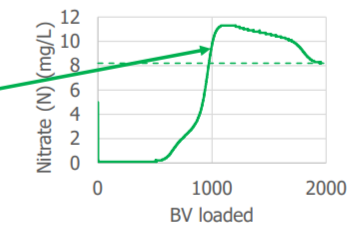
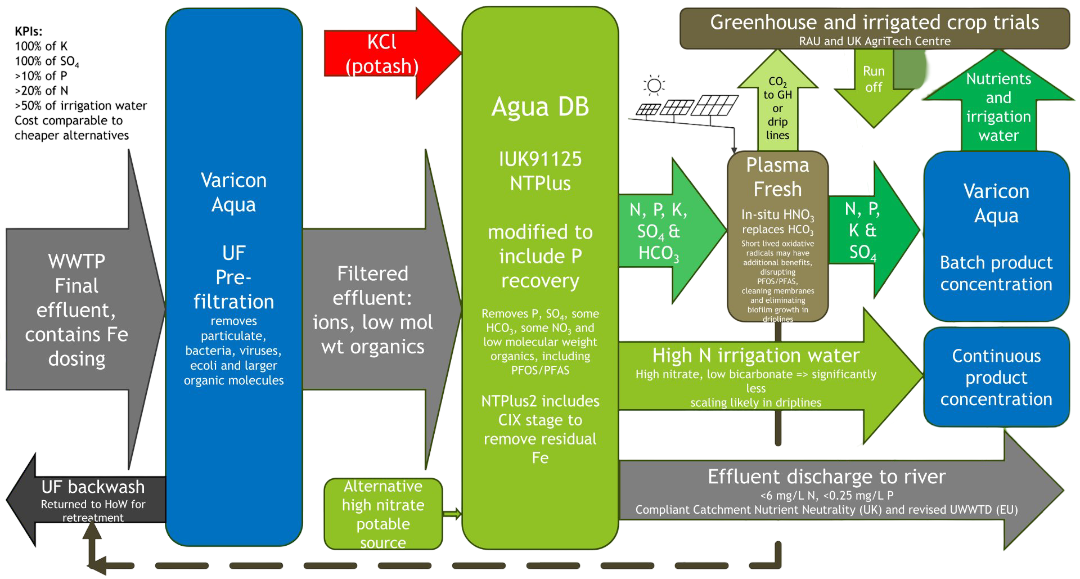
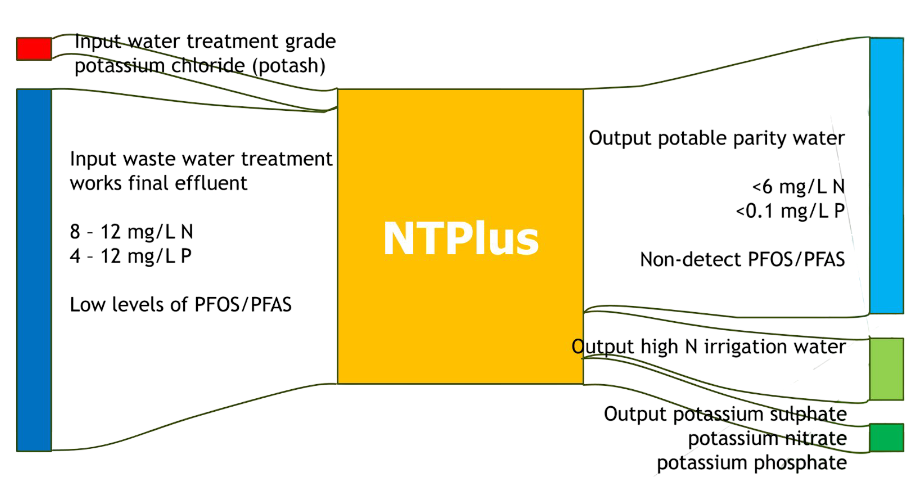
Incoming bicarbonate and sulfate in the raw water displace this re-absorbed nitrate, giving a large nitrate ‘peak’ – ideal irrigation water!
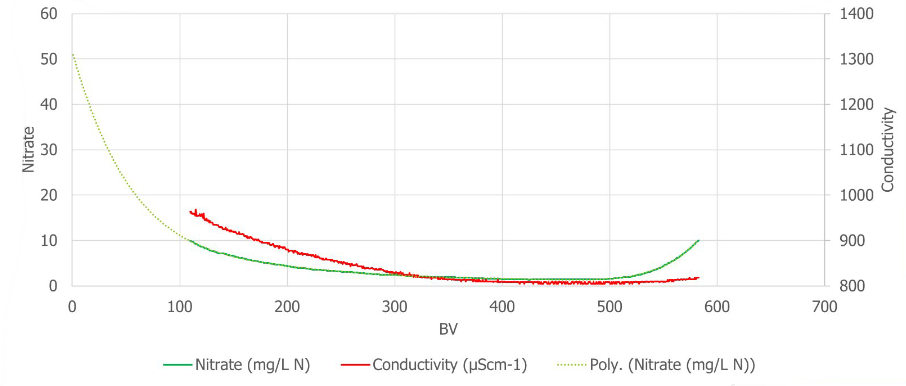
NTPlus service load (potable production)
Average N leakage at N < 8 mg/L = 3.05 mg/L (125 – 575 BV) Average N leakage =2.25 mg/L (the optimum N level for human health) (250 – 550 BV)