
waste water treatment
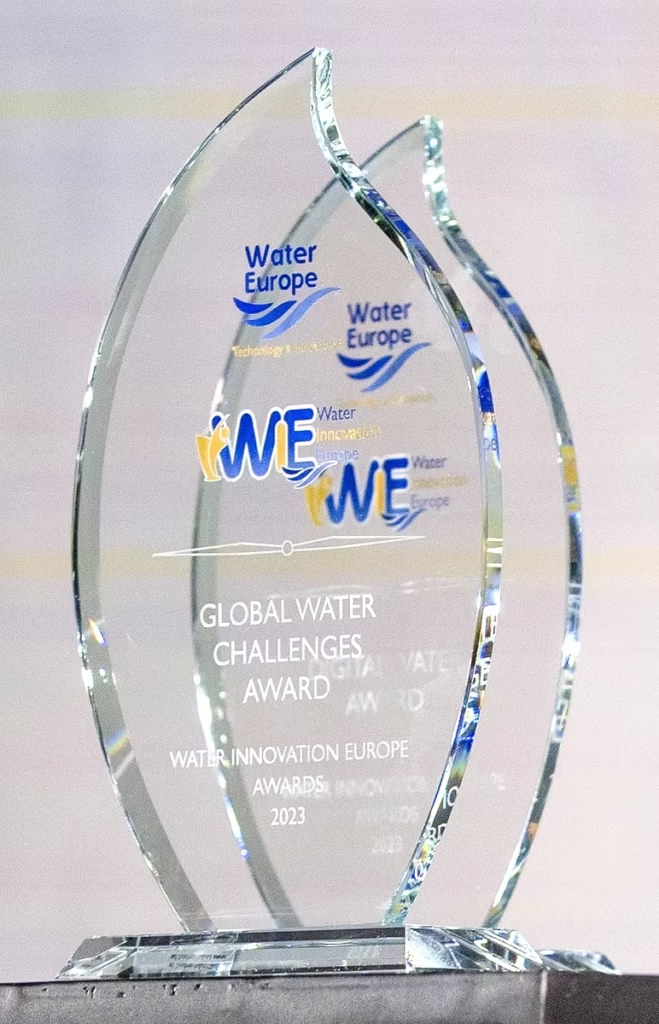
we're really chuffed to announce we recently won Water Europe's 'Global Water Challenges Award' presented at WIE2023, June 21st 2023
Agua DB realised that current ion exchange processes used in the water industry were neither affordable nor sustainable. This had lead to a dysfunctional supply chain, with insufficient business to support a dedicated equipment supplier. The technology needed to change from a linear process, producing a waste, to a circular one, recovering nutrients and other valuable materials for re-use.
Over the years leading up to the formation of Agua DB, we’d realised that the actual behaviour of ion exchange resins in the real world didn’t quite fit what the traditional theories of how ion exchange resins worked. We started asking questions: why do does nitrate peaking occur and how was the resin production process changed to make nitrate selective resins, which overcame this problem? Slowly, we realised that the traditional theory of how a resin was regenerated was not quite the whole story.
We explored what was happening in more detail with Agua DB and realised that it was possible to regenerate more than half of the functional sites on the resin very easily, with the remainder requiring a massive excess of salt to regenerate them. By simply using just enough salt to regenerate these easily regenerated sites, we achieved regeneration efficiencies approaching 100% – a game changing improvement from conventional regeneration which was <10% efficient. We’ve called this new regeneration process NTPlus.
the route forwards
So far, we’re at pilot scale, but working with a number of water companies to scale this up to demonstration scale over the next 2 years in both the US and UK. To keep up to date with how we’re doing, please use our contact page – and we won’t bombard you!
We’d really like to hear from farmers either already irrigating or considering irrigation, particularly if they happen to have a water treatment site on their doorstep (UK and California!). The products can be applied efficiently through rain gun or overhead boom irrigation, but is best suited to driplines and micro-irrigation methods.
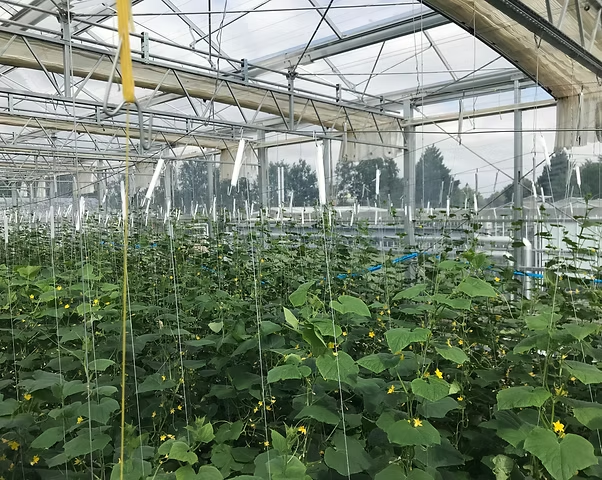
In temperate climates, such as the UK, commercial greenhouses are co-locating with wastewater treatment plant to use spare heat, let’s talk about getting the nutrients and irrigation water from there, too
SMART application submitted October 2022
Investigating potential to recover P
Demonstrating production of variable proportions of potable to irrigation water
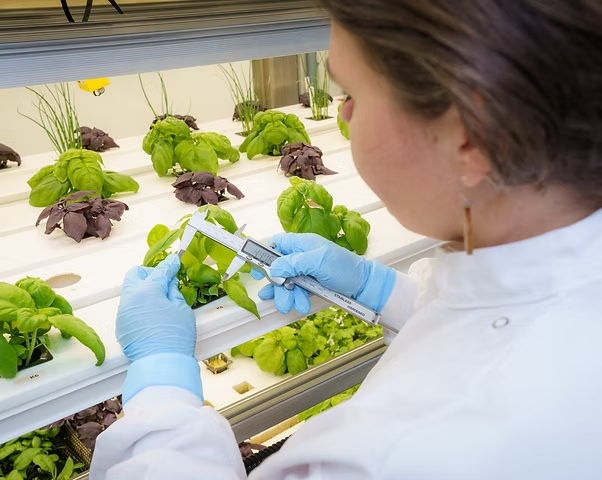
Crop trials on greenhouse tomatoes
Partnership with CHAP https://chap-solutions.co.uk and RAU
Affinity Water, Anglian Water and Thames Water, with EVG Europe, are project advisors
OfWat Discovery
Call opens Jan 2023
Phase 1 – design of integrated plant, product concentration with HPRO
Phase 2 – construct and test integrated plant
Evaluation of produced potable water quality for re-use
Crop trials on irrigated potatoes

US and the rest of the world
We’re actively exploring demonstration opportunities in the Central Valley in California
As this process moves through to commercialisation, we are looking to license the IP and know how, together with key plant design details
We’re a tiny company – this process should go where it is needed and we will work with key partners to deliver this affordably for all
US and the rest of the world
We’re actively exploring demonstration opportunities in the Central Valley in California
As this process moves through to commercialisation, we are looking to license the IP and know how, together with key plant design details
We’re a tiny company – this process should go where it is needed and we will work with key partners to deliver this affordably for all
NTPlus – enabling smarter, sustainable agriculture
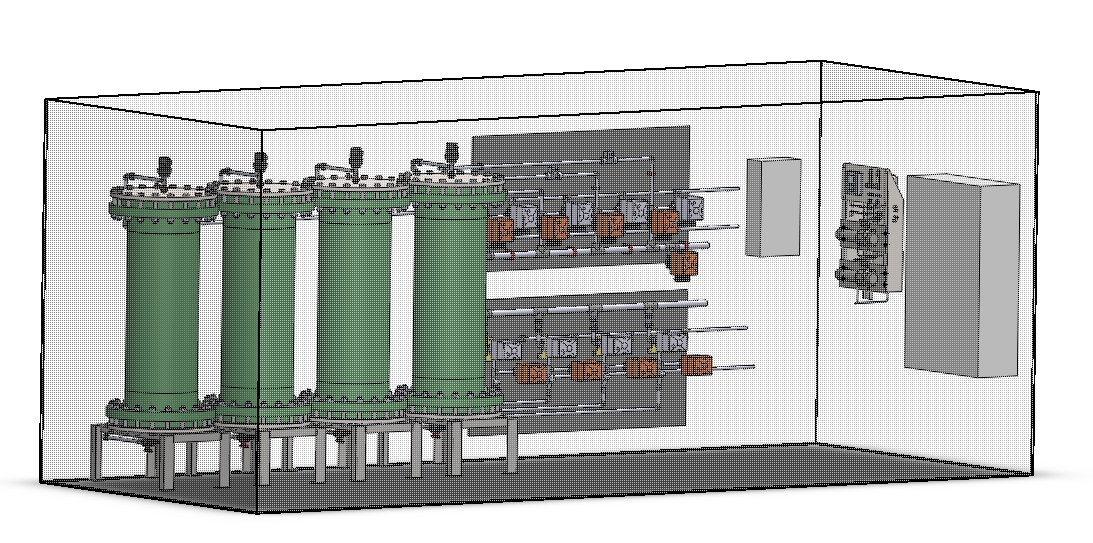
NTPlus is a scalable, low-carbon, nutrient recovery solution that enables sustainable intensification of agriculture - exactly what the planet needs
Introducing NTPlus Technology
- Revolutionises ion exchange: produces low chloride nutrients, not waste
- Recovers low-carbon nutrients: potassium nitrate and sulphate of potash – climate change adaption for crops. We simply cannot make it another way
Key Benefits
- Carbon footprint: just 10% of synthetic fertilisers
- Increases food production cap to >130%
- Converts wastewater into high quality irrigation and pipe-parity water
- Product delivery: Nutrient concentrates compatible with rain fed agriculture
Why it matters
- Enhances climate resilience of crops
- Drives improved nutrient and water use
- Makes nitrate treatment affordable and sustainable
- Replaces phosphate removal with phosphate recovery
